
The Unexpected Reason Founders Get Stuck in the Doer Loop
And how running a specific type of Weekly CEO Review will fix it

You’ve seen the meme, right?
Lucy and Ethel are working on a chocolate factory assembly line. Their job is simple enough: take each chocolate as it comes down the line, wrap it up, and send it on its way.
Seems simple enough.
Then the conveyor belt speeds up, and suddenly chocolates are flying at them faster than they can keep up.
They stuff chocolates into their mouths, hide them in their hats, shove them into their pockets.
Watching that scene would always make me smile…
And then I’d turn around and go do the same thing in my own business.

Psssst…. ADHD, autistic and AuDHD service providers:
The Chocolate Factory You’re Already Running
I don’t need to draw the analogy out for you; you already know how it goes:
Every request, every decision, every Slack message, every approval comes to you.
It’s manageable when it’s coming in slowly.
But then things speed up: the launch gets closer to open cart, the ads finally start working, you’re building momentum …
And all of a sudden you’ve gone from handling things easily to wildly grabbing everything that comes flying at you and hoping you can get it where it needs to go.
The obvious solution is to change the way the chocolate (the work) comes down the pike:
Better delegation, better project management software, another layer of systems.
Anything to slow the work down or divert it so less of it reaches you.
But the thing is, if the business keeps growing, things will keep speeding up. What used to be a manageable trickle of “work only I can do” becomes a flood. The “undelegatable” tasks take over your day.
And you’re back to throwing chocolates all over the place.
Why You Stay On The Doer Loop (Even Though You Know You Shouldn’t)
Now, look, I get it.
Every business needs to get things done; it needs marketing, it needs sales, it needs offers, it needs all of that.
Each of those requires decisions: the work gets done, it gets reviewed, it gets passed on to the next step, the work gets done, it gets reviewed, and so on.
I call this the Doer Loop:
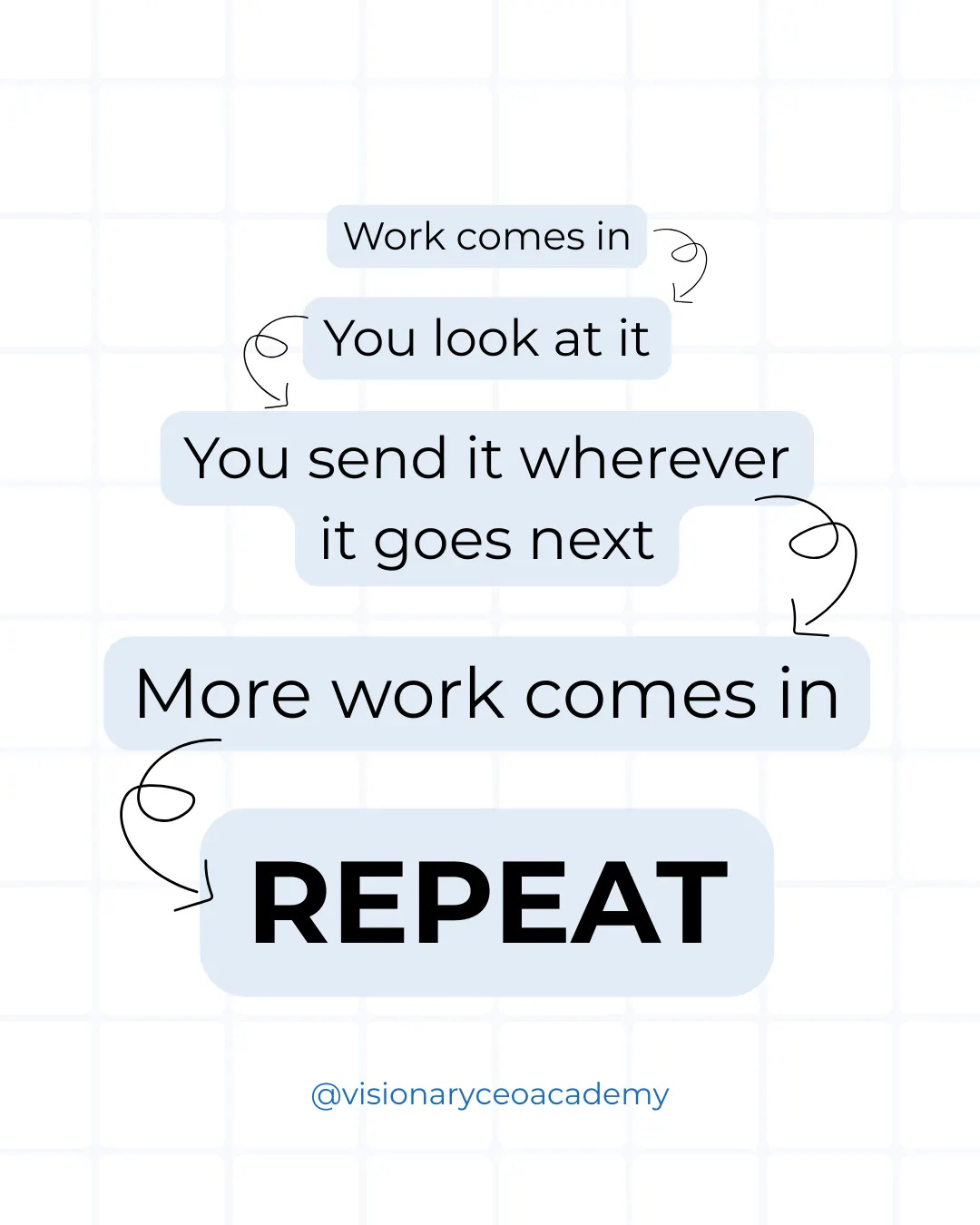
Even if you manage to get AI agents doing most of the actual work, if you care at all about the quality of what goes out under your name and brand…
There are still points where a human needs to step in to do the final QA, to do the approval, to ensure it’s on-brand, and so on.
So the problem isn’t that the loop exists. It has to exist.
And what’s more, it feels good to work inside the loop.
Psychologists call this the Zeigarnik effect: open loops make us uncomfortable. They create a lot of mental noise, and it doesn’t get quiet until the loop is closed. So the tendency to answer the "quick question" isn’t really about the question; it’s because we believe it’s the only way to make the noise stop.
Not to mention, every time we close a loop, it feels like winning: a fast reply, a thumbs-up, a reassigned to-do — each one is a small, immediate, done thing.
Compare that to the actual business growth projects sitting untouched in your someday pile: slow, ambiguous, no finish line for weeks. Even if you want to do them, even if they excite you, the Doer Loop always wins because it pays out in ninety seconds.
The other thing pays out in a month, maybe, if it pays out at all.
But here’s the biggest thing:
The reason you end up in the Doer Loop isn’t because of the loop itself. It’s because you put yourself inside the loop by default.
Every Time the Doer Loop Shows Up, It's Because of This One Thing
So let’s go back to our analogy, and imagine you own a chocolate factory.
Every day on your way into work, you check what’s on your plan for the day. It says “you’re on conveyor belt duty.” So you go straight to the factory floor, put on your hairnet and your booties, walk over to the processing line, and one of two things happens.
Either:
You start picking up chocolates and wrapping them, or
You get in the way of the people who should be picking up the chocolates and wrapping them
And of course, that’s not cheap.
You’ve probably heard of $10,000/hr tasks vs $10/hr tasks, but if not, it goes something like this:
There are things that you could pay someone else to do for $10/hr.
There are other things that, if you were to pay someone else to do them, would cost $10,000/hr.
So, the idea goes, you should spend your time on the $10,000/hr tasks (not the $10/hr ones) — because every hour you spend on a $10/hr task is $9,990 down the drain.
But the math is actually a bit more nuanced than that, because most days you’re not just getting down into the Doer Loop and doing stuff. Your very presence on the line is actually getting in the way of the people who are supposed to be doing that work: waiting on your sign-off, asking questions or chatting you up “since you’re here anyway.”
Even if you only have 2 team members, and they only need ten minutes of your time twice a day, and that happens each day…
That adds up to 3+ hours of your team’s time that’s being spent managing you instead of making things happen.
Which means the choice to “just hop in for a minute” becomes a five-figure decision by the time you tally up a year of Mondays.
All because your plan for the week was built for a Doer — so when you looked at your calendar and it told you to walk down to the factory floor, you did.
Here's the Fast Way to Get Out of the Doer Loop
Most people plan their week by looking at what’s coming up.
And they do a separate weekly review where they evaluate what already happened, what got done, and what’s still outstanding.
But these shouldn’t be two separate activities; they should be two parts of the the same equation.
Enter the Weekly CEO Review. It differs from the traditional “weekly review” in three key ways:
1. It Predicts the Unpredictable
Rather than treating “what happened” and “what’s coming up” as separate things, the CEO Review bridges the gap.
The truth is, most “unpredictable” things are actually quite predictable. Chip and Dan Heath call this setting a tripwire — a pre-set condition that flags a problem while there's still time to act on it, instead of waiting to trip over it after the fact.
It’s just that we don’t stop to do the prediction, so we end up reacting:
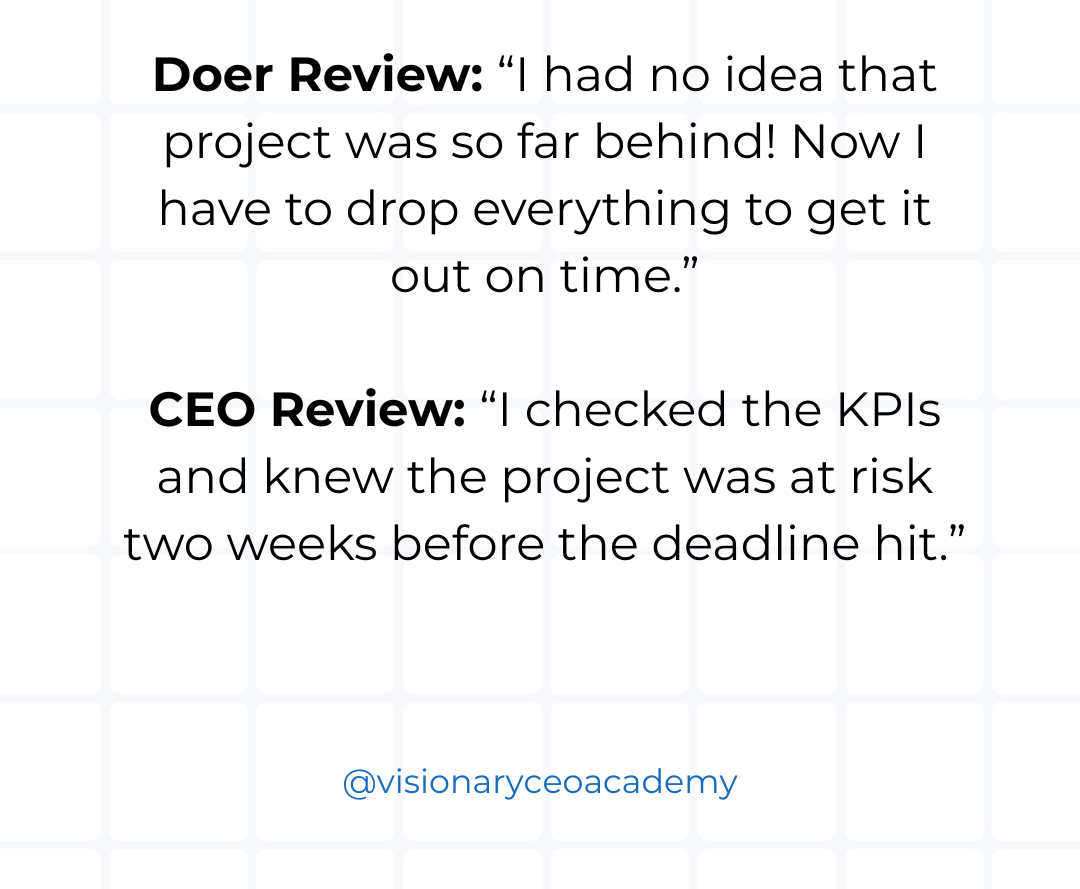
A CEO Review changes this by explicitly connecting the dots between past performance and what needs attention this week.
That way, when you plan your week, you already know which project is at risk before the deadline forces your hand — meaning you can put time on the calendar for it now instead of dropping everything for it later.
Action Step: Take a look at one of your KPIs right now and ask: based on this KPI, what could need attention this week?
Then, put time on your calendar to either address it with the appropriate team member (if it’s someone else’s job) or to deal with it yourself (if it’s yours).
Pro-Tip: a KPI that’s on track could mean nothing’s needed, or it could be a sign that someone needs a high-five.
2. It Works with the Week You Have
Another reason that the typical weekly review fails is that it’s paired with an idea that sounds great in theory: the model week.
(That’s where you dedicate the same block of time every week to the same type of work, so Monday mornings are for planning, Tuesday afternoons for client calls, etc.)
But a model week is, by definition, a fictional week: one where nothing comes up, energy is constant, and every week looks like the one before it. Daniel Kahneman and Amos Tversky called this the planning fallacy: it’s when we tend to plan as though the best-case version of events is the default, even though something almost always comes up.
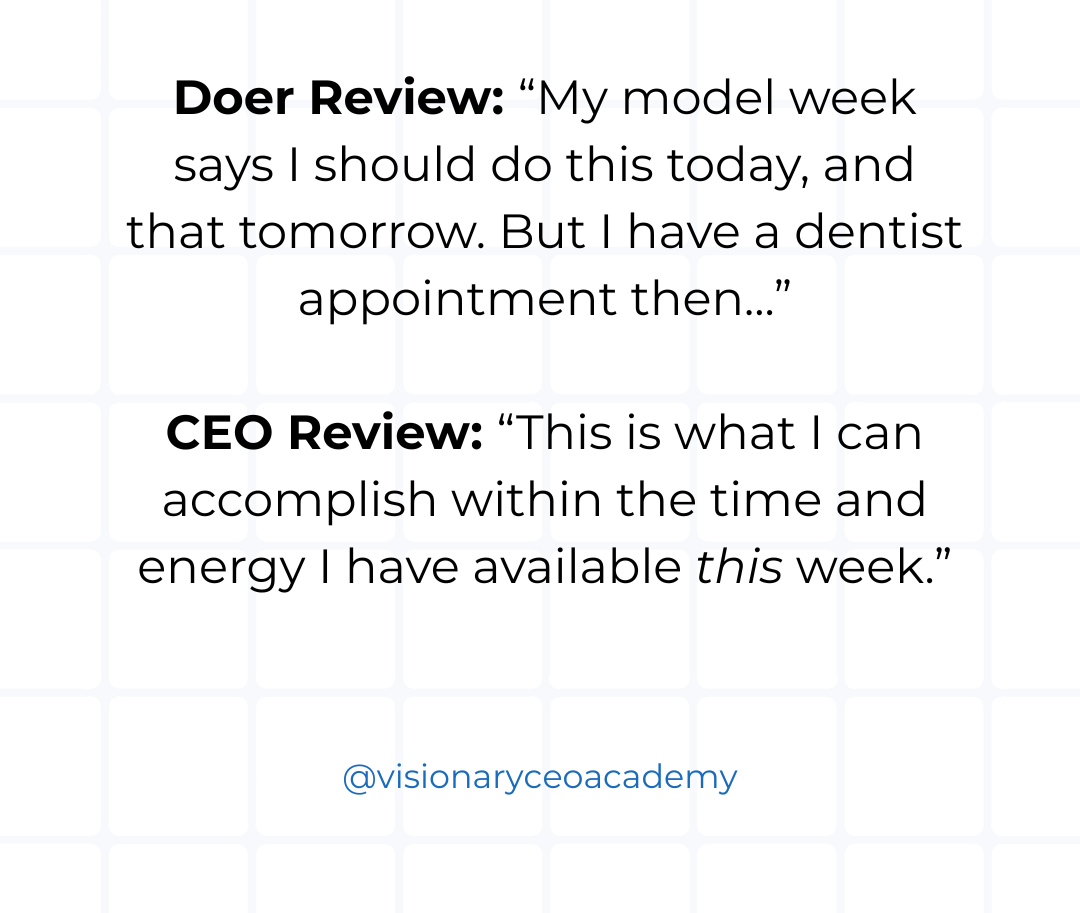
It's not that model weeks are a bad idea. It's that they describe a week you don't actually have — and the gap between the model and the reality is exactly where you get pulled back into the Doer Loop.
Action Step: Before you add a single thing to your plan for next week, check your family calendar, the kids’ sports calendar, the work calendar, and the paper calendar you put on your wall in the office when you did annual planning way back in January.
Block them all off first, so you’re planning around what’s already true (and not around a version of the week where none of it exists)
3. It Pre-Fills The Important Work
Here’s the thing about empty space on your calendar: it doesn’t stay empty.
That open hour at 2pm on Thursday that you think you’ll spend mapping out next month’s marketing campaigns?
If it’s not actually set aside, you’re just as likely to get to 2pm and catch yourself saying "I just need to finish up one thing on this client project, and then I can get to it…”
Only to realize 45 minutes later that your quick “5-minute task”… wasn’t.
In my experience, there are three types of things that usually don’t make it onto your plan: time to delegate, time to work on creative projects, and time for the random stuff that always crops up.
But when you do a Weekly CEO Review, you’re reminded each week of what you could (or should) delegate, what your strategic priority is, and that not everything will go to plan…
Meaning that time for those things goes into your plan automatically, not when you think of it.
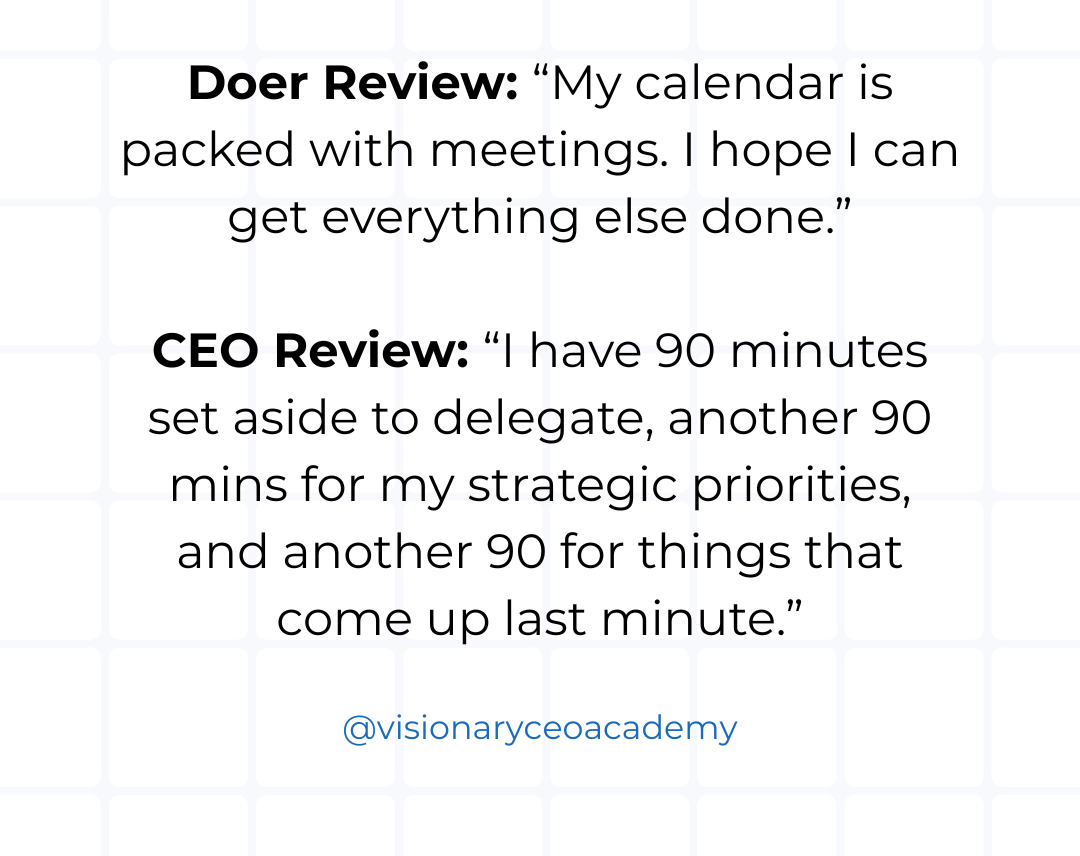
Action Step: Before anything else goes on your calendar this week, block 90 minutes for flex, 90 for delegate, and 90 for strategic work.
Put them in before you load in any tasks or deadlines for the week — whatever’s left over after they’re placed is what’s actually available for everything else.
How One Client Turned the Doer Loop Into a Business That Runs Without Her
On the TV show, Lucy and Ethel never got off the line.
That’s the joke, actually. The belt just keeps speeding up until the scene cuts to commercial — chocolates still flying, both of them still stuffing their hats.
But that’s television.
In real businesses, it doesn’t have to be that way.
One of my favorite examples of this is Keila. A few years back, she’d hit the point where, in her own words, “I cannot take another phone call and I cannot answer another email. And so I wanted to love my work again. I wanted my life back.”
She’d already hired a team — and was still working 12-hour days anyway. More people just meant more people to manage. Hiring hadn’t gotten her off the conveyor belt; it had just put more people on it with her.
So she rebuilt how work reached her instead. Client questions stopped landing on her desk by default and started routing straight to whoever actually owned that part of the business. Her team started talking to each other instead of waiting on her.
But the thing I remember most was the day she did a Weekly CEO Review for the first time.
It was a Friday afternoon, and she was just completely overwhelmed.
We did the review together, and built her plan for the coming week. Then, we set up daily check-ins to make sure she had what she needed.
On Monday, the check-in was easy: everything was on track.
By Tuesday, she was shocked at how much she’d been able to get done.
And by Wednesday? She told me she didn’t need the daily check-ins any more, because of how much everything had already changed.
That’s what happens when you start planning your week like a CEO:
You still get to run the factory.
You just don’t have to work the line anymore.
PS. Want the tool that runs my Weekly CEO Review for me?
Click the link below and you’ll get instant access — no opt-in required. In less than 8 minutes, you’ll have your review done and your plan for the week ready to rock.
FAQs
Q: Isn’t this just a fancy to-do list?
No. A to-do list tells you all the things you could be doing; a Weekly CEO Review decides how much time and space you have available, what the priorities are, and who should be doing each piece.
The to-do list list is what’s left over after those decisions get made — it’s not the plan itself.
Q: I’ve tried weekly reviews before and always end up in the weeds. Why would this be different?
Most weekly reviews are look-backs: they ask what happened, not what to do about what’s coming. That’s useful information, but doesn’t change how you show up on a day-to-day basis.
A Weekly CEO Review starts with the assumption that your time should be spent like a leader not a doer — and fills in the rest from there.
Q: Not everything is predictable. What do I do then?
That’s what the flex block is for. Think of it as the release valve: the point in the week where the things you truly couldn’t predict go, so that it doesn’t fill up your strategic time.
Q: Do I need a big team for the delegate block to actually work?
No. Even if you have just one part-time VA, asking “could someone else do this?” every week is still worth it. It’s not about team size — it’s about whether the you’re asking the work before you take it back onto your plate by default.
Hi, I’m Breanne (she/her), and I’m the co-founder of VisionaryOS.
It’s the first (and only) software purpose-built for ND service providers, designed to take all the “could dos” currently swirling inside your head, and prioritize them based on your current time, money, and energy constraints.
Try a free demo today at https://visionaryos.app/demo/top3